New National Collaborative Links Local Housing Justice Efforts
UPDATED JAN. 20, 2026
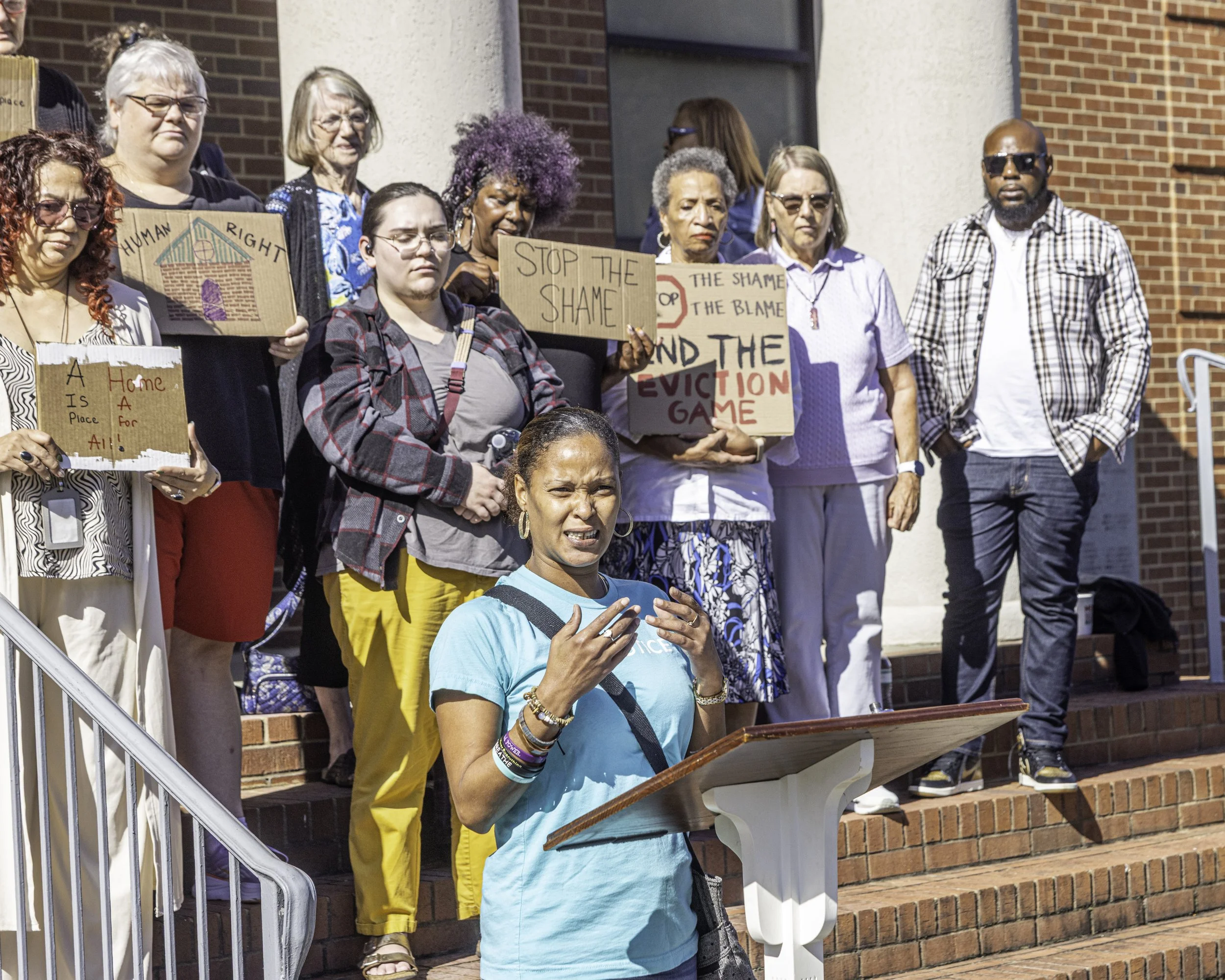
On Oct. 2, 2025, MORE Justice, a Columbia, South Carolina–based network of faith congregations working for housing justice, held a press conference to push for passage of a state bill now under consideration. If passed, it would seal eviction records after six years and wipe cases from the public record after 30 days when evictions are dismissed or settled.
On the same day, dozens of MORE’s members pursued a phone banking effort. A contingent of activists fanned out to knock on doors across the Greenview neighborhood. All were mobilized to spread the word about a new MORE campaign to illuminate housing issues through the eyes of children.
Prior to the press conference, members had attended trainings on working with media and conducting effective phone banking and in-person canvassing. The events generated an article in the local press. All told, volunteers made 50 phone calls, knocked on 170 doors, and talked to 70 residents.
Such preparation, action, and results would have been difficult or impossible for the small MORE Justice staff to accomplish alone. Instead, the local members’ efforts were amplified by the help, advising, and participation of more than 30 housing advocates from diverse organizations across the U.S. The volunteers converged in Columbia to share advocacy expertise, wisdom from lived experience, and put feet on the ground.
The surge of assistance from afar came thanks to a new nationwide collaborative called Bridge to Power, a nonprofit housing justice collaborative. The initiative launched in early 2025 to build capacity, leadership strength, and mutual support among a group of 10 local and statewide housing justice groups. Participants represent nine states spanning all regions of the country.
“Bridge to Power assists where we just don’t have the capacity ourselves to do it,” says Robynne Campbell, a MORE Justice volunteer and member of its housing steering committee. “This isn’t a one-organization fight, and Bridge to Power puts those organizations together to assist in that fight.”
Bridge to Power members on a bus on their way to an action in Seattle. Photos courtesy of Bridge to Power
Seeds Planted in an Earlier Campaign
The Bridge to Power collaboration has its roots in a 2023 campaign and national tour led by Katy Heins and Michael Anderson when they were part of the Housing Justice Team at Community Change, a nonprofit focused on racial justice. The Put Tenants First campaign, whose early planning began in 2020, was designed to bring attention and action from the U.S. Department of Housing and Urban Development (HUD) to housing issues across the country.
The tour brought advocates from multiple organizations to four cities: Akron, Ohio; Cottage Grove, Oregon; Lafayette, Louisiana; and Washington, D.C. In each location, the Put Tenants First volunteers invited local HUD representatives to see firsthand some of the housing problems and solutions in low-income communities, focusing on substandard living conditions and landlord accountability.
The organizations that were involved in that effort—and now are in the Bridge to Power collaborative—vary in specific missions and local action priorities. But they share certain key values, Anderson says, including that housing justice is inextricably tied to racial and gender justice and that people with lived experience must be at the decision-making table, driving the discussion about housing solutions.
Heins and Anderson wanted both HUD officials and housing advocates from geographically separated areas to see that problems that might appear hyperlocal are shared by many communities. Their aim, they say, was to exert pressure on HUD to take a broader view and avoid labeling local issues as out of their jurisdiction.
“We invited national HUD to come out, and bring their local HUD folks, to talk and be ledby actual tenants about what’s happening in housing in their communities,” says Heins, “making the connection that it’s not just this building in Lafayette, Louisiana, not just this these tenants in Akron, Ohio—the same thing is happening everywhere.”
The Put Tenants First tour culminated in August 2023 with a meeting in Washington, D.C., with then–HUD Secretary Marcia Fudge. Its leaders count among its effects the subsequent dedication of $10 million by HUD for tenant organizing efforts, along with significant base-building and leadership development in the participating organizations. After the campaign ended, Community Change shifted its anti-poverty focus away from housing, but the organizations that had participated in the national tour wanted to stay in touch and keep the community-building and information-sharing going.
“When it came to an end, we were like, ‘No, this can’t happen,’” says Campbell. “Several of us stayed in contact. We continued sharing information and helping each other. And we encouraged Katy and Michael [who had been laid off from Community Change] to just keep fighting. We all met in Detroit to try to figure out the next step, because this work is truly in need of support, and it can’t just fall through the cracks.”
Allyson Putt, policy manager for the Detroit People’s Platform (DPP), a solidarity movement representing the city’s Black communities, concurs.
“We took stock and said, ‘We’ve been working together, we built this body of knowledge, we’ve started understanding how we work together as a collective,’” says Putt, whose organization was also part of the Put Tenants First campaign. “It was more than a task force. . . . We had built powerful relationships, and there was a desire and a need for more work to be done.”
Putt began convening monthly meetings with the other organizations, initially just to keep together the housing organizing community that had been built. “There was a very strong sense of community purpose,” says Putt, “and drive to keep the momentum going.” But then those meetings became the foundation of formalizing something new. The group asked Heins and Anderson if there was anything the pair could do to coordinate keeping the group together. The two reached out to funders who had supported the Put Tenants First campaign. Two of the key funders—the Oak Foundation and Fund for Housing and Opportunity—agreed to support Bridge to Power through the Social Good Fund, a California nonprofit that provides fiscal sponsorship for emerging community and environmental sustainability projects.
… Our partners deeply know what they’re doing, what they need, and how they can work with one another to advance that. What they don’t have is the capacity to bring themselves together.”
Michael Anderson
Bridge to Power launched officially in January 2025 as a collective effort among 10 organizations. The group operates under a loose hierarchy, with a five-member steering committee and Anderson and Heins holding coordinating roles. The collective calls itself an “organizing blueprint” that aims to “amplify local housing solutions and ignite national collaboration to win homes for all.”
Its second major convening was in Columbia, South Carolina, in October, scheduled to coincide with—and provide people power for—the MORE Justice eviction bill action and canvassing. At that gathering, members adopted a three-year plan defining programs and goals. The collaborative plans to focus on building capacity for each organization to address its unique goals and needs, rather than adopting a national strategy or policy campaign. Capacity-building methods include in-person and virtual gatherings to share ideas and provide training, coaching, and mentoring on strategy and leadership development.
Anderson contrasts Bridge to Power’s participatory approach to previous approaches using a metaphor: “When we were at Community Change with these same partners, we had a sense of what food they would want and like, what food was nutritious and would get them where they wanted to go. And we would invite them to a buffet and say, ‘These are all the great things that we have to offer, and we know you want some of them,’” he says. “What this model is like, is that our partners say, ‘You know what? We already know how to cook delicious, nutritious food that’s just what we want. What we need is to be able to come in together in a potluck and have somebody to help us coordinate.’”
He adds, “In other words, the content and the direction don’t need to come from a national source at the top. This model says that our partners deeply know what they’re doing, what they need, and how they can work with one another to advance that. What they don’t have is the capacity to bring themselves together and put themselves in a position where they can dive in together and make advancements.”
As examples of these joint efforts, he mentions the media training delivered by Bridge to Power partners with media experience prior to the Columbia press conference, along with in-person training on door-to-door canvassing and phone banking. In Seattle, Bridge to Power provided training on how to hold a public teach-in. Such trainings have a ripple effect, he notes, with partner organization leaders, staff, and volunteers developing durable skills and capacities they can apply to their local policy campaigns and share with others.
Local Leaders Describe the Value of a Collaborative Network
All of Bridge to Power’s partner organizations are committed to furthering policies and practices that increase housing for all, Anderson says, though each may have different methods and local focus areas.
In Detroit, DPP is working in coalition with other organizations to counteract over a half-century of damage and injustice in the city’s Black communities. The group has scored several policy victories over the past decade, including tenant right to counsel and a housing trust fund with a dedicated annual funding stream, Putt says. It is now pushing to broaden affordable housing strategies beyond tax-credit financing through social housing strategies such as setting up community land trusts and reinvesting in public housing. Bridge to Power supports this work because it “connects DPP to other organizations working on housing across the country, which helps amplify our message in a noisy landscape,” wrote Putt in an email.
Putt notes that one of Bridge to Power’s concrete benefits is that not only can they learn from the best practices of other organizations on topics such as narrative and strategy, but the collaborative enables more people to access such training and peer exchanges by covering travel and accommodation costs, and especially child care costs, for its out-of-town convenings.
“At DPP, we have a unique space with long-term volunteers who are directly impacted people with lived experience,” she says. “So what is really wonderful about Bridge to Power is that we are always encouraged to bring our volunteers. They then can interact with people around the country and be exposed to other ideas.”
In Oregon, Michelle Thurston lives in an affordable housing community for the elderly and people with disabilities in Cottage Grove, a city of 10,000 about 130 miles south of Portland. Cottage Grove was one of the Put Tenants First tour stops. Thurston serves on the board of her county’s housing agency and is a founding member of Residents Organizing for Change (ROC Oregon), a statewide advocacy network of affordable housing residents and front-line staff that pushes for statewide policies around homelessness, affordable housing, and tenant rights. She ticks off several ways Bridge to Power has already had an impact, especially through support of trainings and information-sharing sessions.
“One of the biggest things Bridge to Power does is that education piece, providing opportunities for people to learn at different paces and engage in different ways. For instance, we just had a conversation with New Hampshire on Zoom, talking about ‘This is what’s working, this is what didn’t work and why.’ We don’t have to recreate the wheel. We can adapt it to Oregon, to our rural areas and coastal cities.”
Freedom ROC (Righteous Organizing Collaborative) in Akron, Ohio, works to build leadership and community power among low-income Black residents in several Ohio cities. Besides focusing on local policy issues such as tenant right to counsel and establishing a phased security deposit policy, the organization pushes for broader systems changes such as decommodifying housing and establishing housing as a human right.
Rev. Raymond Greene Jr., Freedom ROC’s executive director, stresses how connection across geography helps people grasp the universal nature of some of the more pressing problems.
“Although politics are local, this is a national problem that we’re having—not only with housing, but with safety, police brutality, and lack of economic investment,” Greene says. “Bridge to Power allows for us to collect regular, ordinary people, in Akron, in South Carolina, in Detroit, that are going through the same thing they’re going through, so they don’t feel shame, or feel that it’s their fault, but that this is a systemic problem. We’re able to connect all these different cities, all these different states, to build a nationwide narrative that allows us to contend for power on a federal level.”
Greene is on Bridge to Power’s steering committee and serves as a trainer, delivering political education and leadership development workshops for the partner organizations. In turn, he says, he brings back insights from their work.
“In South Carolina, they have a huge faith-based contingent. So learning how they are bringing churches in, how they are bringing pastors in, it’s very interesting,” he says. “And then, in Detroit, the way they’re working on a land bank, a housing [trust fund]. In New Orleans, they’ve got a structure to ensure that people get on their feet and qualify for housing outside their program—they’re using their housing program as a three- or four-year building block to get people prepared financially and mentally to go purchase a home.”
What’s next?
Besides DPP, Freedom ROC, MORE Justice, and ROC in Oregon, the 10 Bridge to Power partners include Action NC in North Carolina, the Charleston Area Justice Ministry in South Carolina, New Hampshire Tenants Union, Residents Action Project/Washington Low-Income Housing Alliance, Residents Organizing for Housing Louisiana, and Residents United Network/Housing California.
Over the first year, funding has come mainly from foundation support, but also from individual donors and some fee-for-service work. Future work will include seeking out more philanthropic supporters, as well as expanding the other funding streams, Anderson says.
Bridge to Power is not currently planning any major expansion. Anderson and Heins emphasized the value of a small, close-knit group in maintaining familiarity and trust. Anderson suggests that if Bridge to Power shows itself to be a successful model, then scaling up could mean the emergence of other, independent collaborations around the country where organizations can mutually build capacity.
“We see this as a way to have deeper relationships,” says Heins. “If you have 50 or 60 organizations, how deep can your relationships really be with all of them?”
One of the biggest challenges, Anderson says, is having the patience to grow an effort like this as carefully and slowly as needed.
“What’s hard is that for all the participating organizations, there is urgency. In their communities there are people without adequate housing protections right now, suffering. And of course now they’re in the crosshairs of this violent, aggressive regime. And so people are very, very busy,” says Anderson. “And so one of the things that we need to be very mindful of is not racing ahead, even though the urgency calls us to race ahead. We have to be patient at a time where patience seems almost impossible. it’s a challenge, but it’s also a great opportunity.”
Editor’s Note: This article has been updated to correct Robynne Campbell’s last name. Shelterforce apologizes for the error.